

Istanbul Walls Walking Tour – This is not a museum walk. It’s a real urban hike, a long, satisfying, boots-on-the-ground route that follows the legendary
Land Walls of Constantinople (the Theodosian Walls) from the Sea of Marmara side all the way toward the Golden Horn.
You start at the dramatic fortress gates of Yedikule / Altın Kapı, pass restored and renovated wall sections,
stop at major gates (Belgrad Kapısı, Mevlanakapı, Fetihkapı, Edirnekapı), visit the Palace of the Porphyrogenitus (Tekfur Sarayı),
and finish in Balat with a coffee overlooking the Golden Horn.
Table of contents
- Quick overview: distance, time, difficulty
- The full route (step-by-step)
- What you’ll see (and why it matters)
- Practical tips: safety, photos, and timing
- Optional variants and shortcuts
- FAQ
Quick overview: distance, time, difficulty
| Item | What to expect |
|---|---|
| Total walking distance | ~ 10–12 km (depending on detours and street crossings) |
| Time needed | 3.5–5.5 hours (with photos + Tekfur Palace visit) |
| Difficulty | Easy to moderate (long walk, uneven sidewalks, some hills near the Golden Horn) |
| Best seasons | March–June and September–November (cooler air, better light, fewer crowds) |
| Best start time | 08:30–09:30 (for softer light and calmer streets) |
You will mostly walk beside the walls on public streets and paths. Some restored sections have visitor areas.
Treat it like a heritage hike rather than a continuous wall-top walk.
Interested to visit the walls with a guide ?
Accessibility note: this is a real urban hike (not always smooth)
This walk is amazing, but it’s not the most “easy-access” route in Istanbul. Think of it as a heritage hike rather than a simple promenade.
You’re following a long defensive line inside a dense city, so the path is not continuous and not always comfortable.
- You will alternate sides: sometimes you walk on the roadside (outer side) of the walls, and sometimes on the inner side through neighborhood streets and small paths.
- Expect detours: fences, rail lines, big roads, and closed sections can force you to re-join the wall line after short loops.
- Uneven surfaces: broken sidewalks, steep curbs, rubble-like edges near wall sections, and occasional muddy patches after rain.
- Not stroller-friendly: a stroller is possible only on parts of the route, but overall it’s frustrating. For families, a carrier is easier.
- Best approach: treat the walls as your “spine”, and accept that you’ll cross and switch sides to stay safe and keep moving.
Don’t aim for a perfect, continuous line. Aim for the sequence of gates and restored sections.
If you keep hitting the key waypoints (Belgrad Kapısı → Mevlanakapı → Fetihkapı → Edirnekapı → Tekfur Sarayı), you’re doing the walk correctly.
The full route (step-by-step)
Start: Altın Kapı / Yedikule Kapısı (Golden Gate area)

Begin at Yedikule, where the walls meet the Sea of Marmara side. This is the most cinematic starting point:
massive stonework, fortress atmosphere, and the famous Golden Gate (Altın Kapı) legacy.
Give yourself 15–25 minutes here just to absorb the scale.
- Meeting point idea: near Yedikule Kapısı / the fortress perimeter
- Photo tip: step back and frame the gate + wall line to show the “defensive rhythm” of towers
Segment 1: Yedikule → Belgrad Kapısı (Belgrade Gate)
From Yedikule, follow the wall line north-west. This section already sets the tone:
long stretches of towers, grassed moats in places, and a constant sense of “walking the edge” between historic structure and modern city.
You’ll reach Belgrad Kapısı, one of the notable renovated stops.
- What to watch for: alternating towers, layered masonry repairs, and the wide defensive footprint
- Micro-break: pause at Belgrad Kapısı for close-up detail shots and gate geometry

Segment 2: Belgrad Kapısı → Mevlanakapı → Dördüncü Askeri Kapı
This is the “rhythm” part of the hike: steady walking, repeated towers, occasional street crossings,
and sections where restoration makes the wall line feel newly “readable”.
You pass Mevlanakapı and continue toward Dördüncü Askeri Kapı (Fourth Military Gate),
a more understated stop that still feels like a hidden checkpoint in a long defensive machine.
- Best mindset: don’t rush—this is where the walls become a living landscape
- Navigation tip: keep the wall on your right/left consistently (depending on your street side) and re-join after crossings

Segment 3: Dördüncü Askeri Kapı → Fetihkapı → Edirnekapı Walls
As you approach Fetihkapı and then Edirnekapı, the surroundings change—more hills, broader views,
and a stronger “gateway” feeling. The walls here can be especially impressive in the afternoon light,
but the morning is calmer and more comfortable for a long hike.
- Highlight: Edirnekapı is one of the most iconic wall areas for scale + presence
- Short pause: this is a great point for water and a snack before the museum stop

Stop: Palace of the Porphyrogenitus (Tekfur Sarayı)
From Edirnekapı, you cut slightly toward Tekfur Sarayı—a rare surviving piece of late Byzantine palace architecture
sitting right by the walls. The visit adds a “human layer” to the fortifications:
you go from defense engineering to imperial life and courtly fragments.
Plan a quick visit (30–60 minutes) depending on your pace.
For official visiting info and current rules, check:
Tekfur Palace (official Istanbul Municipality info)
Finish: Tekfur Sarayı → Balat → café with Golden Horn view
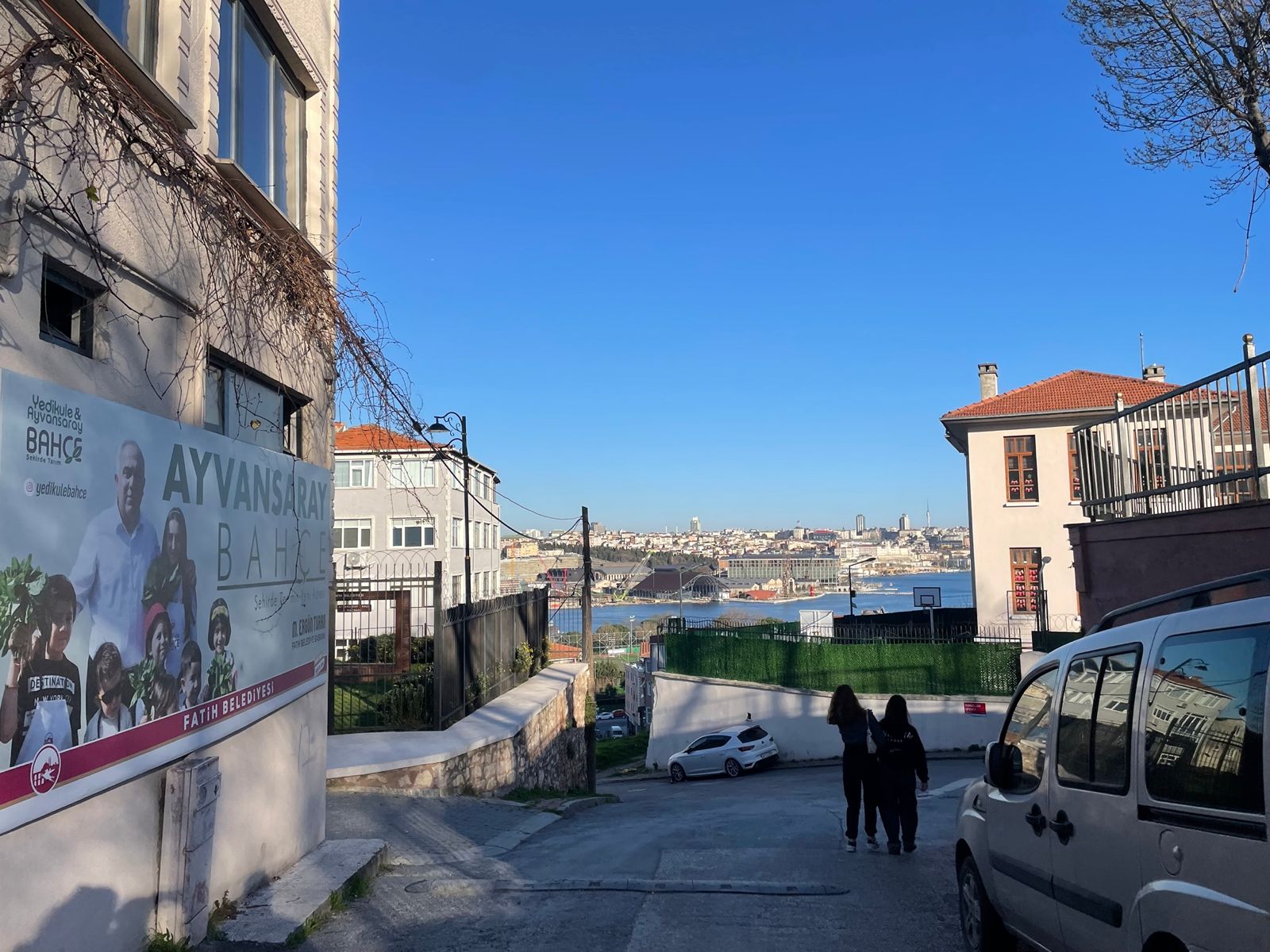
After Tekfur Sarayı, head downhill toward Balat (and nearby Fener). The vibe shifts completely:
colorful streets, neighborhood energy, and the waterfront atmosphere of the Golden Horn.
End the walk the best way possible: find a café terrace facing the water
around the Balat / Fener shoreline and reward yourself with tea or coffee while you look back at the city you just crossed.
Order something warm, sit facing the Golden Horn, and mentally “trace” the wall line you followed from Yedikule.
It makes the whole route click.

What you’ll see (and why it matters)
- Golden Gate / Yedikule legacy: ceremonial power + fortress defense in one start point.
- Gate sequence: each kapı is like a chapter marker in the city’s defensive story.
- Restored segments: easier to understand how the layered wall system worked (inner wall, outer wall, moat).
- Tekfur Sarayı: a rare “palace” counterpoint to the military architecture.
- Balat finish: the perfect contrast—historic neighborhoods and Golden Horn calm after stone and towers.
Practical tips: safety, photos, and timing
Safety and comfort
- Wear real walking shoes. Sidewalks can be uneven and some stretches feel like “city hiking”.
- Stay on public paths. Don’t climb or enter restricted wall areas unless clearly open to visitors.
- Carry water. You’ll walk long stretches where shops can be sparse.
- Use offline maps. The wall line can require small detours around roads and fenced areas.
Photo strategy (simple but effective)
- Morning: softer light on stone texture, fewer people.
- Look for repetition: tower–wall–tower patterns tell the story better than a single close-up.
- Use gates as anchors: each kapı is a natural “chapter break” for your photo set.
Optional variants and shortcuts
- Short version (2–3 hours): Start at Belgrad Kapısı and finish at Edirnekapı + Tekfur Sarayı.
- History-heavy version: Add short stops for nearby Byzantine/Ottoman landmarks around Edirnekapı and Fener.
- Sunset version: Do the final descent into Balat late afternoon for Golden Horn light (but start earlier to avoid rushing).
FAQ
Is it a continuous walk “on top” of the walls?
No. Think of it as a long walk along the walls. Some restored points have visitor access, but the route is mostly street-level.
Is this walk suitable for families?
Yes for active families who enjoy walking. Keep it flexible: break it into segments, carry water/snacks, and avoid the hottest hours.
How do I get back after Balat?
Balat/Fener connects well to public transport options and taxis. The main idea is: finish relaxed, then choose the fastest return based on your next plan.
What’s the single “must-do” stop on this route?
If you only pick one extra beyond the gates, pick Tekfur Sarayı—it adds a rare palace layer to the wall story.